Let’s talk about AI ROI.
You’re measuring AI on revenue. The real cost is hiding somewhere else entirely.
Every board meeting, every strategy session, every quarterly review — the question is the same.
What’s our AI ROI?
Leaders are tracking time saved, tasks automated, revenue influenced, costs reduced. All legitimate metrics. All important data points.
And all measuring the wrong thing.
Because while organizations are laser-focused on what AI is doing for the business, almost nobody is measuring what AI is doing to the people running it.
And that gap — the human performance gap — is quietly swallowing the returns leaders think they’re generating.
MIT Sloan Management Review and Boston Consulting Group named five workforce risks that should factor into every AI deployment decision. Most organizations haven’t assigned anyone to own them. Many haven’t even considered them.
That’s not a technology problem. That’s a leadership problem.
The Blind Spot in Your AI Strategy
Here’s the uncomfortable truth: the ROI conversation around AI is almost entirely focused on output. Speed. Volume. Efficiency.
What it ignores is the human infrastructure required to sustain those gains.
When AI is deployed without deliberate workforce strategy, five risks emerge — not eventually, not theoretically, but now, quietly, inside your team.
And because they don’t show up on a dashboard, most leaders never connect them to the performance gaps, the turnover spikes, the slower decisions, or the cultural erosion they’re already seeing.
The cost isn’t hypothetical. A 2018 Gartner report found that suboptimal decision-making at a $5 billion revenue firm cost it $150 million per year.
Scale that to your business.
One bad hire. One missed client signal. One strategic misstep made by a leader running on cognitive fumes.
What is that worth?
The 5 Workforce Risks Nobody Is Tracking
- Overreliance — Employees stop thinking. AI fills the gap.
When AI handles enough of the cognitive work, people stop exercising the judgment muscle. Not consciously. Gradually.
They defer to the output. They skip the verification. They trust the suggestion over their own read of the room.
And when AI gets it wrong — which it does — nobody catches it, because the human who should have caught it stopped looking.
- Deskilling — Critical capabilities atrophy from disuse.
Skills not practiced are skills lost.
This is not metaphor — it is neuroscience. When employees stop writing, analyzing, problem-solving, and deciding independently, those neural pathways weaken.
The capability doesn’t disappear overnight. It erodes slowly, invisibly, until the moment you need it most and discover it’s gone.
- Cognitive Overload (Brain Fry) — Too much monitoring creates fatigue and errors.
The assumption that AI reduces workload is only half true. For many employees, AI creates a new category of work: constant oversight, correction, and quality control of machine outputs.
Research found that workers managing four or more AI tools reported declining productivity and 39% more major errors than those who don’t experience this overload.
More tools.
More fatigue.
More mistakes.
Less of what you actually deployed AI to achieve.
- Job Displacement Uncertainty — Morale and performance drop when roles feel threatened.
You don’t have to actually eliminate a role for the damage to begin. The perception of threat is enough. When employees believe AI is coming for their position, engagement drops, discretionary effort disappears, and your best people — the ones with options — start looking. The AI research is highlighting that workers experiencing AI-related cognitive strain showed a higher intention to leave, compared to those who didn’t.
Uncertainty has costs hidden in plain sight.
- Widening Inequality — AI amplifies top performers and leaves others further behind.
AI is a multiplier. Which means it multiplies what already exists.
High performers with strong judgment, clear priorities, and refined skills get exponentially better with AI support.
Employees already struggling — with unclear roles, inadequate training, or weak fundamentals — fall further behind.
The gap widens.
Fast.
And a team with a widening performance gap is not a scaling team. It’s a fracturing one.
AI Doesn’t Create These Risks. It Exposes Them.
This is the principle most leaders resist — because accepting it means accepting responsibility.
AI doesn’t manufacture overreliance. It reveals that you never built a culture of critical thinking.
AI doesn’t cause deskilling. It exposes that skill development was never systematized.
AI doesn’t create cognitive overload. It surfaces the fact that workflow design was never intentional.
AI doesn’t generate displacement anxiety. It uncovers the reality that your people never had enough clarity about their value to feel secure.
AI doesn’t widen inequality. It amplifies a performance gap that leadership already allowed to grow.
Every one of these risks is a leadership gap wearing an AI mask. And the organizations that will thrive in this environment are not the ones deploying the most AI — they are the ones with the leadership infrastructure strong enough to handle it.
The Work Smart Approach: Assign Ownership
Every one of these risks maps directly to a performance lever. And every performance lever has an owner — you.
Check out the table below highlighting the workforce risk. I have paired with a Work Smart principle.
Use the ‘Leadership Questions’ to problem solve before you add in another AI tool or automation.
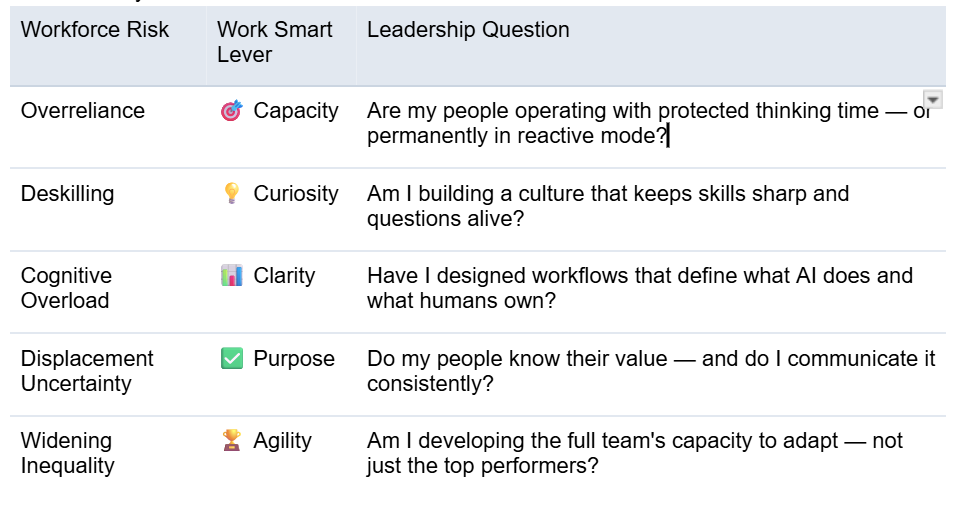
This is the framework. Assign a lever. Assign an owner. Measure it.
Because what gets owned gets managed. And what gets managed gets results.
The ROI of AI is not just what it generates. It’s what it doesn’t destroy in the process.
The leaders who close this gap first will have a compounding advantage their competitors won’t be able to replicate — because the asset they’re protecting isn’t technology.
It’s human judgment. And that’s still irreplaceable.
Find out which of these five risks is biggest in your business.
Take the free AI Readiness Gap Assessment at worksmartclubnetwork.com — and get a clear picture of where your AI deployment is leaking performance before it costs you more than you realize.
Dr. Cynthia Howard is an AI Business Growth Strategist and executive coach helping service-based leaders close performance gaps in an AI-driven world.