Something is happening to the smartest, most capable leaders in the room.
They’re making more mistakes. They’re less decisive. They feel perpetually behind despite getting more “done.” They’re reactive instead of strategic. And at the end of the day, despite a mountain of output, they feel strangely empty.
This isn’t a motivation problem. It’s not a discipline problem. It’s not even a time management problem.
It’s a thinking problem — and AI is accelerating it.
Your Brain is Your Personal Hardwired Computer.
Unlike your device, you have more than an on and off switch.
Your brain operates in two distinct modes.
Shallow thinking is fast, reactive, and automatic. Psychologist Daniel Kahneman called it System 1. It’s the brain running on autopilot — pattern-matching, scrolling, skimming, approving, clicking.
It’s efficient. It’s effortless. And it’s exactly the mode that AI rewards.
Deep thinking is slow, deliberate, and intentional. System 2. It’s the mode engaged when you wrestle with a hard decision, sit with a problem long enough to see the real root, feel genuine empathy for a client’s situation, or ask yourself what you actually want from your business and your life.
It requires stillness. It requires resistance. It requires you to stay with discomfort instead of outsourcing it.
Here’s the hard truth: your brain is hardwired to take the path of least resistance.
When shallow thinking is rewarded — with speed, with outputs, with the dopamine hit of a completed task — the brain starts to wire itself accordingly.
Neural pathways strengthen with use and weaken without it. The more you delegate your thinking to AI, the more your brain defaults to surface-level processing.
Not because you’re getting dumber. Because that’s exactly how neuroplasticity works.
You become what you repeatedly do — cognitively.
The Consequences Are Not Small
This isn’t philosophical. It’s costing you.
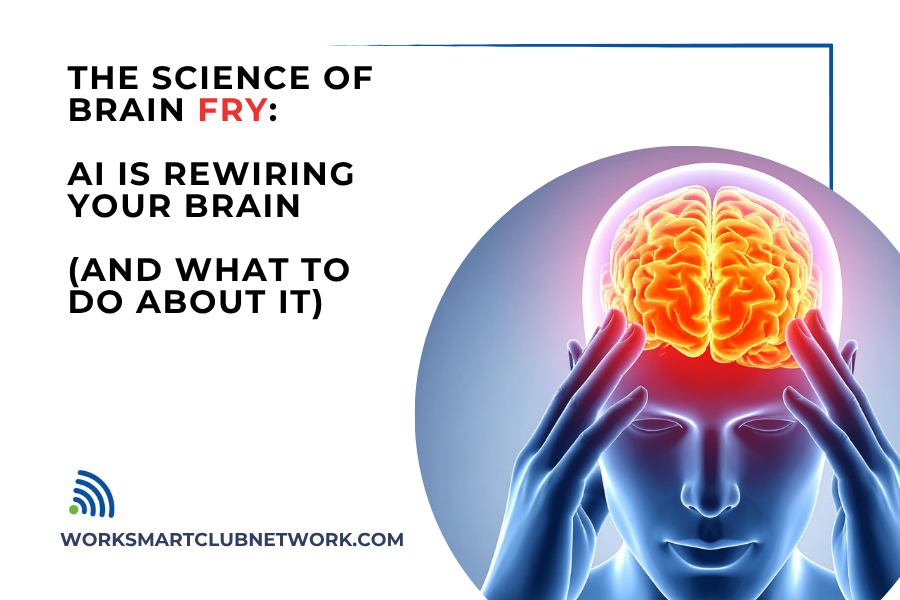
Brain fry — the cognitive overload that comes from constantly monitoring, correcting, and managing AI outputs — is now affecting 1 in 7 knowledge workers.
Research found that workers experiencing it make 39% more major mistakes and show 33% more decision fatigue than those who don’t.
And it’s not coming from hard work. It’s coming from a specific kind of cognitive taxation: low-depth, high-volume mental processing with no recovery.
Think of it like this: shallow thinking at scale is the cognitive equivalent of doing a thousand tiny bicep curls with no rest and calling it strength training.
The muscle doesn’t grow. It seizes.
Hair-trigger stress reactions are next. When the prefrontal cortex — the seat of your executive function, judgment, and emotional regulation — is chronically depleted, the amygdala takes over.
Your brain’s threat-detection system becomes hypersensitive. Minor friction feels like crisis. Ambiguity feels like danger. You react before you respond.
Leaders running on shallow thinking don’t just make worse decisions — they make them faster and with more emotional volatility.
And then there’s the meaning problem — the one nobody talks about.
Meaning is not built in shallow water. It is constructed in depth.
The neuroscience is clear: your brain’s Default Mode Network — the system activated during rest, reflection, mind-wandering, and abstract thought — is where you process identity, values, empathy, and long-term vision.
It’s where you ask the questions that matter: Why am I building this? What kind of leader do I want to be? Is this the life I actually chose?
When you’re in constant task mode — generating, approving, prompting, editing, switching — the Default Mode Network goes dark.
You’re too busy doing to ever be. And over time, that creates a quiet but devastating erosion of satisfaction.
High output.
Low fulfillment. A growing sense that something essential is missing — even when everything looks fine on paper.
Abstract Thinking Is Not a Luxury. It’s a Leadership Skill.
Abstract thinking — the ability to zoom out, hold complexity, connect disparate ideas, and reason about things that don’t yet exist — is the highest-order cognitive function you have.
It’s what makes a great strategist.
A visionary leader. A trusted advisor. It’s what separates the owner who runs the business from the one the business runs.
And it is the first casualty of AI overuse.
When your brain defaults to shallow thinking, abstract reasoning atrophies. You lose the ability to sit with ambiguity.
You become addicted to the clarity of a prompt-and-response loop — a world where every question has an instant answer, every problem has a suggested solution.
Real leadership doesn’t work that way. Your clients don’t work that way.
The complex, human, messy problems you’re hired to solve require a brain that can tolerate uncertainty long enough to find truth.
The leaders who will win in an AI-accelerated world are not the ones who use AI the most. They’re the ones who use their minds the most — and deploy AI strategically to amplify that thinking, not replace it.
The Work Smart Solution: Both. Always Both.
Shallow thinking is not the enemy. It’s necessary. You need fast, efficient, automated processing to move at the pace this environment demands.
The goal isn’t to slow down — it’s to build both speeds so you can consciously choose which one the moment requires.
That means deliberately protecting time for deep thinking — not because it feels good, but because your capacity, your clarity, your resilience, and your sense of purpose all depend on it.
It means treating reflection as a performance lever, not a personality preference. It means creating margins — even 5 minutes before you open an AI tool — where your brain solves the problem first.
And it means recognizing that AI, at its best, is an amplifier. It makes clear thinking clearer and confused thinking more confused. If you haven’t built the thinking infrastructure, AI will accelerate the leak — not plug it.
The question is not whether you’re using AI.
The question is whether you’re still using your mind.
Dr. Cynthia Howard is an AI Business Growth Strategist and executive coach helping service-based leaders close performance gaps and thrive in an AI-driven world. Book your free 30-Minute Leadership Gap Analysis.